Triple-shock rear suspension explained: how the XP2 separates roll and heave
How the MMC XP2's three rear dampers work, why they let you tune roll and pitch separately, and how to set them up with the flex slider.
Published 23 October 2026
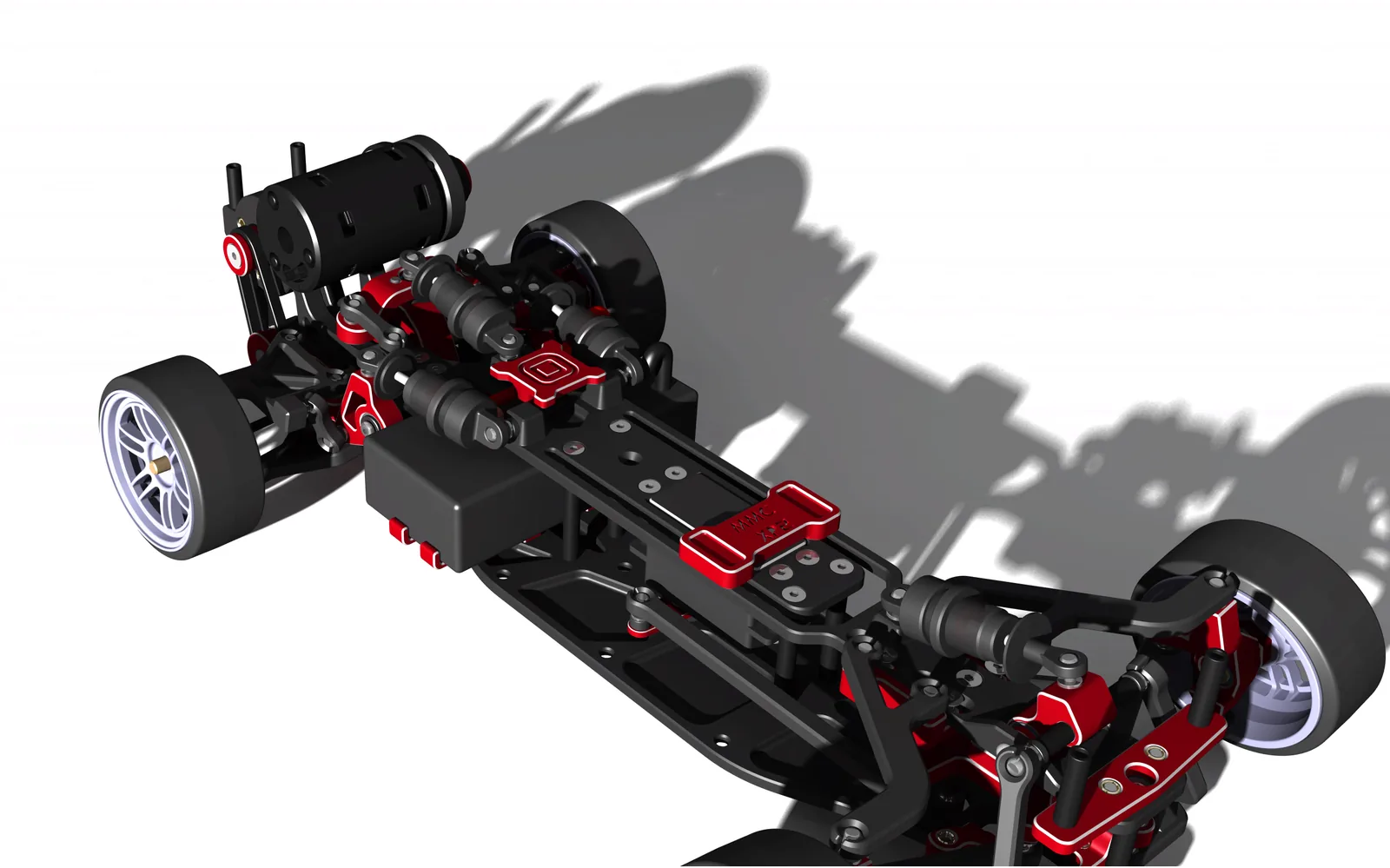
The XP2 is the only MMC chassis with three dampers at the rear: one on each side and one in the middle. It sounds like complexity for its own sake. It isn’t: it lets you tune how the rear rolls and how it pitches almost independently.
How it works
The rear is a double wishbone suspension with three dampers:
- The two side dampers work all the time, under both vertical and lateral loads.
- The central damper works only under vertical loads: heave, when both sides of the rear move up or down together. It is driven by the rear heave crank.
Because the central damper ignores lateral loads, the suspension’s response to vertical loads and to lateral loads is partly decoupled. By changing how stiff the side dampers are relative to the central one, you adjust the rear’s roll and pitch separately.
Why not a conventional layout
Two things change from the XP1, and it helps to keep them apart:
- The arm layout. The XP1 rear is a multi-link. Adding the triple shock added complexity, so on the XP2 the arms were simplified to a double wishbone.
- How the dampers work. This is what the triple shock really changes. The XP1’s dampers are conventional and cannot separate heave from roll. The XP2’s can.
Why pull-rods
Systems like this one always use bellcranks to drive the dampers. On the XP2 the rear uses pull-rods rather than push-rods, purely for packaging: there was no layout with push-rods that fit the rest of the components.
Setting it up
After testing, the clear finding was that softer side springs make the car livelier, with more roll, which adds realism to the driving.
The oil sets how fast all of this happens. Thinner oil gives quicker movements, thicker oil slower ones. Which you prefer comes down to your driving.
Triple shock and the flex slider
The XP2 also has a flex slider that sets how much of the rear’s roll reaches the front. The two interact, and this is how the four extremes feel:
| Rear roll (side springs) | Flex slider | Result |
|---|---|---|
| Soft | Back | The car moves a lot laterally, but not much of the rear’s force reaches the front |
| Soft | Forward | The rear’s lateral movement is transferred to the front: more front grip |
| Stiff | Back | Not much movement at all |
| Stiff | Forward | A brick that gives you no feedback |
The best combination is a lively rear (soft side springs) with the front grip tuned on the slider. With soft side springs the car rolls more, and the flex system can send more of that movement to the front.
The front end
The XP2 keeps the front mono-shock of the XP1, already proven on that chassis. It complements the triple-shock rear well.
Keep reading
- Tech explained
Chassis flex in RC drift: how the MMC flex slider works
Why the XP1 and XP2 use a flex slider instead of a sway bar, what moving it forward or back does on track, and how to set it up.
- Tech explained
Front mono-shock suspension on a 1:10 drift chassis: how it works on the XP1 and XP2
Why the MMC XP1 and XP2 use a single central front damper, its pros and cons against two dampers, and how to set it up.
- How-to and buying guides
XP1 vs XP2 vs D3: which MMC drift chassis should you build?
Suspension, drivetrain, adjustability and shopping list of the three printable MMC RC drift chassis, side by side, to help you pick the right one.