Chassis flex in RC drift: how the MMC flex slider works
Why the XP1 and XP2 use a flex slider instead of a sway bar, what moving it forward or back does on track, and how to set it up.
Published 23 October 2026
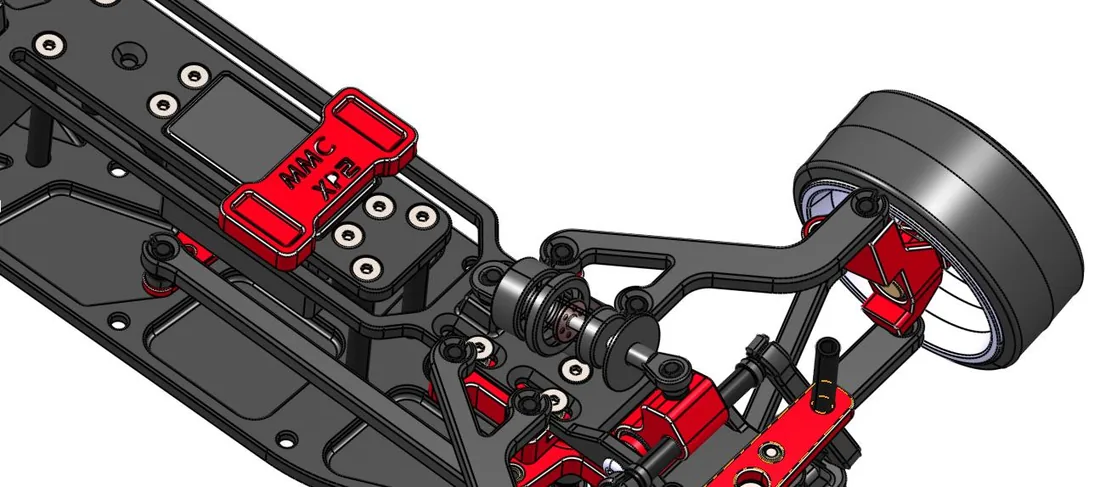
The XP1 and XP2 have a part you won’t find on other drift chassis: a slider that sets how much the chassis can twist. It is the reason the front mono-shock works, and it is the quickest way to change how the car feels without touching a damper.
Why the chassis needs to flex
Both XP chassis use a front mono-shock: a single damper for both front wheels. A mono-shock handles loads that hit both wheels at once, like braking and accelerating (pitch). It does not let the front roll on its own.
Without another way to absorb body roll, the car would be far too stiff. The flex slider is that other way. Instead of a conventional sway bar, the chassis itself twists, and the slider controls how much. It gives the front the freedom it needs so the mono-shock can do its job.
What moving the slider does
The slider has no fixed positions. It moves along a continuous range, so you can set it exactly where you want.
| Slider | Chassis | What you feel on track |
|---|---|---|
| Further back | More torsional flex, more relative movement between front and rear, less force transmitted forward | Smoother and easier to drive |
| Further forward | Stiffer, more of the rear’s roll is transferred to the front | More front grip and a more nervous front end, harder to drive |
In short: forward is aggressive, back is forgiving.
Which position to use
It depends more on your driving style than on the surface: the slider behaves predictably on every surface it has been tested on.
Our recommendation is towards the back, for a smoother, more fluid drive.
The most common mistake
Setting it too far forward from day one. Start with the chassis free (slider back) and move it forward step by step as you get to know the car, to add aggressiveness only when you can use it.
Flex slider and mono-shock: two separate jobs
They don’t interact, they coexist. If you adjust one, you don’t have to re-adjust the other:
- The mono-shock works on loads that affect both front wheels equally: acceleration and braking (pitch).
- The flex slider works on lateral loads: body roll.
On the XP2 there is a third system in the mix, the triple-shock rear suspension. How soft you set the rear roll changes how much movement the slider can send forward; that article covers the combinations.
The Top Adjustable Flex Regulation upgrade
On the original XP1 and XP2, the adjustment screws of the flex system sit underneath the chassis, which makes them awkward to reach. The Top Adjustable Flex Regulation replaces those parts with new ones that put the screws on top, so you can adjust the flex trackside without flipping the car.
It fits both the XP1 and the XP2.
Keep reading
- Tech explained
Front mono-shock suspension on a 1:10 drift chassis: how it works on the XP1 and XP2
Why the MMC XP1 and XP2 use a single central front damper, its pros and cons against two dampers, and how to set it up.
- Tech explained
Triple-shock rear suspension explained: how the XP2 separates roll and heave
How the MMC XP2's three rear dampers work, why they let you tune roll and pitch separately, and how to set them up with the flex slider.
- How-to and buying guides
XP1 vs XP2 vs D3: which MMC drift chassis should you build?
Suspension, drivetrain, adjustability and shopping list of the three printable MMC RC drift chassis, side by side, to help you pick the right one.