Front mono-shock suspension on a 1:10 drift chassis: how it works on the XP1 and XP2
Why the MMC XP1 and XP2 use a single central front damper, its pros and cons against two dampers, and how to set it up.
Published 23 October 2026
Most 1:10 drift chassis have one damper per front wheel. The XP1 and XP2 have one damper for both. This is where the idea comes from, what it gives you, and when it is not the right choice.
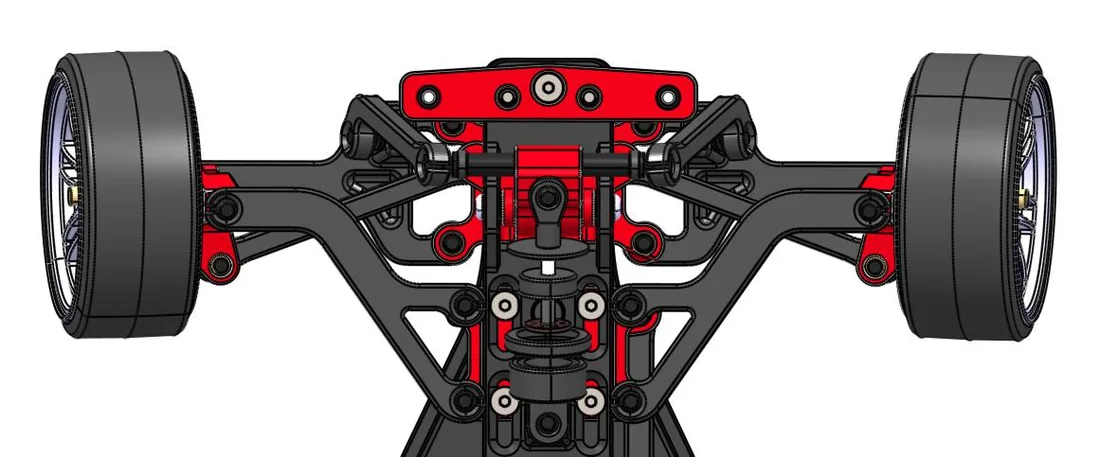
Where the idea came from
Mono-shock front ends show up in several branches of motorsport, from hillclimb cars to Formula 1. Those cars were the inspiration for the XP series.
The MMC version does not work exactly like them. In the full-size systems, the bellcrank can slide sideways against springs to absorb lateral loads. That was impossible to replicate at 1:10 scale. The answer was to let the chassis itself absorb those lateral loads, which is why the XP1 and XP2 have a flex slider.
How it works
Both front wishbones drive one central damper through a bellcrank. The damper reacts to loads that hit both front wheels at the same time: braking and accelerating (pitch). Body roll is handled by the chassis flex, set with the slider.
Mono-shock vs two dampers
The D3 uses the conventional layout, with one damper on each front wishbone, so you can compare both approaches across the MMC range.
Advantages of the mono-shock
- Less weight.
- Fewer parts creating friction.
- A simpler front end.
- More room for the wheels at full steering lock.
Disadvantages
There is only one, and only on irregular surfaces. Because the arms on both sides are linked, bumps and imperfections are not absorbed as well as with fully independent suspension. On smooth surfaces it has no drawbacks.
Setting it up
- Spring. The right stiffness depends on how you place the electronics on the chassis, because that sets the weight on the front. There is no single correct spring.
- Oil. A very thin oil gives a lively, reactive feel, and it is what we run.
- Stiffness. Adjust it with the spring preload on the damper, as on any conventional car.
When not to use it
On very irregular surfaces, like very aggressive asphalt or a bumpy track, a fully independent front end will absorb the surface better. On smooth surfaces such as P-tile, carpet or polished concrete, the mono-shock has no downside.
On the XP2
The XP2 kept the mono-shock from the XP1, and it pairs well with the XP2’s triple-shock rear suspension.
Keep reading
- Tech explained
Chassis flex in RC drift: how the MMC flex slider works
Why the XP1 and XP2 use a flex slider instead of a sway bar, what moving it forward or back does on track, and how to set it up.
- Tech explained
Triple-shock rear suspension explained: how the XP2 separates roll and heave
How the MMC XP2's three rear dampers work, why they let you tune roll and pitch separately, and how to set them up with the flex slider.
- How-to and buying guides
XP1 vs XP2 vs D3: which MMC drift chassis should you build?
Suspension, drivetrain, adjustability and shopping list of the three printable MMC RC drift chassis, side by side, to help you pick the right one.